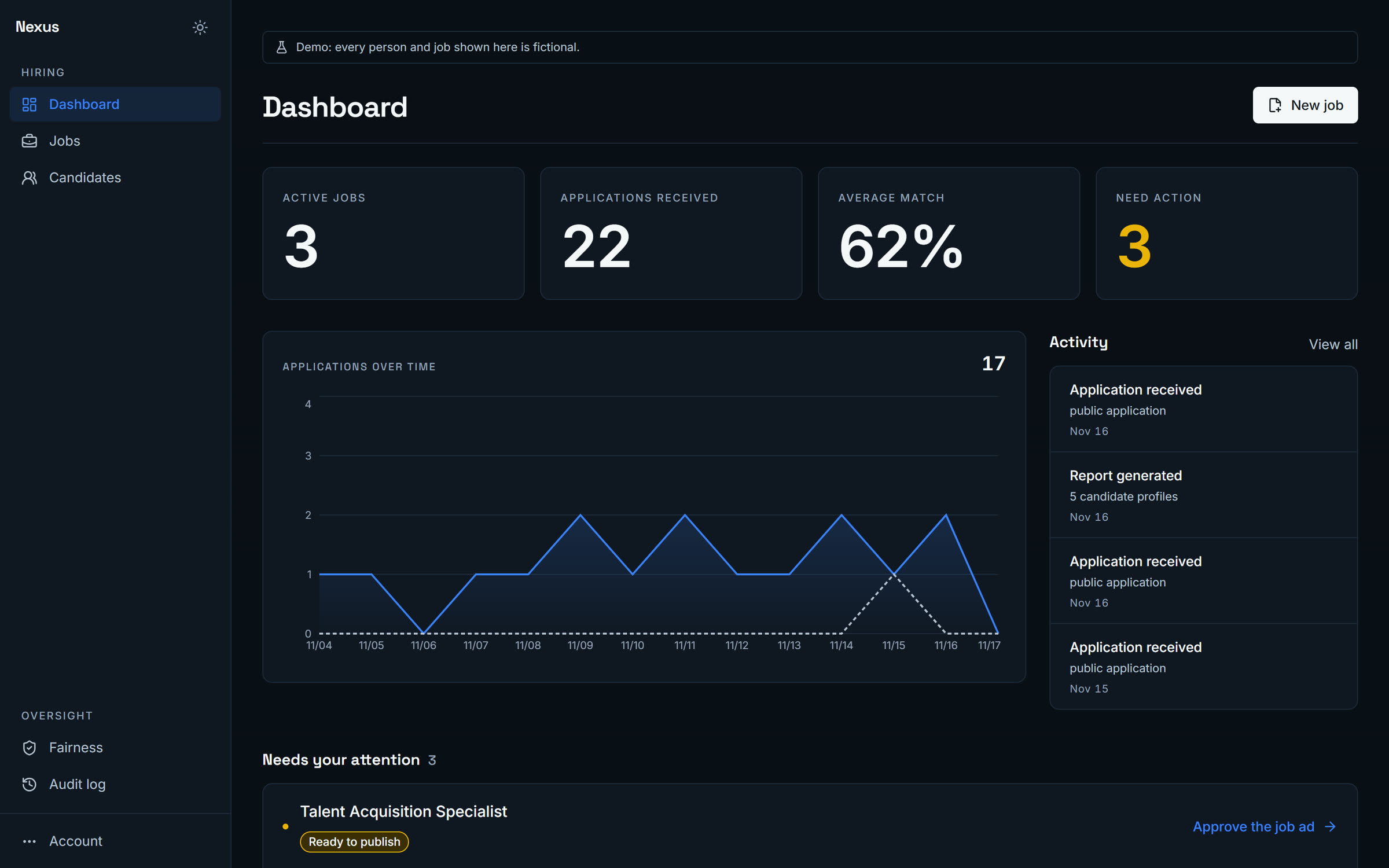
Every job moves from what you provide, through what Nexus computes, to what you decide. Amber marks a decision that belongs to a person, here and in the product.
Role
Parameters
Job ad
Applications
Score
Review
Trace
What you provide
A role, described in a sentence or as an existing job ad. Then the applications, received through a public page or imported by your team.
What Nexus computes
It structures each CV, computes five published criteria, and drafts the job ad, interview questions and rejection emails. Every number can be traced back.
What stays with you
Approving the brief, the job ad and any rejection list. Deciding who to interview and who to hire. Nexus sends no email to candidates.
The walkthrough.
Seven steps, in the order the product runs them. Each one says why it exists and what happens next. Change any value: the arithmetic is the product’s own.
Why this step existsScreening starts from what the role needs, not from the CVs. One sentence is enough: Nexus asks for the rest.
Describe the role
What Nexus asks next
The required skills
The minimum years of experience
The location, the contract type and the work arrangement
Already have a job ad? Paste it instead, and this scoping step is skipped. The language you choose applies to everything the candidate reads, and cannot be changed afterwards.
What happens nextYou confirm the answers. That confirmation is the first of up to three human checkpoints.
Why this step existsThese three parameters are carried into the job ad you approve next, and every score is computed against that approved ad. Fixing them before any CV is read keeps every candidate on the same scale.
Set the parameters Example configuration
Required skills
You approve the brief
Nothing moves to the job ad until a recruiter confirms these parameters.
What happens nextNexus drafts the job ad from this brief and your company profile. Your company profile shapes the ad, never a score.
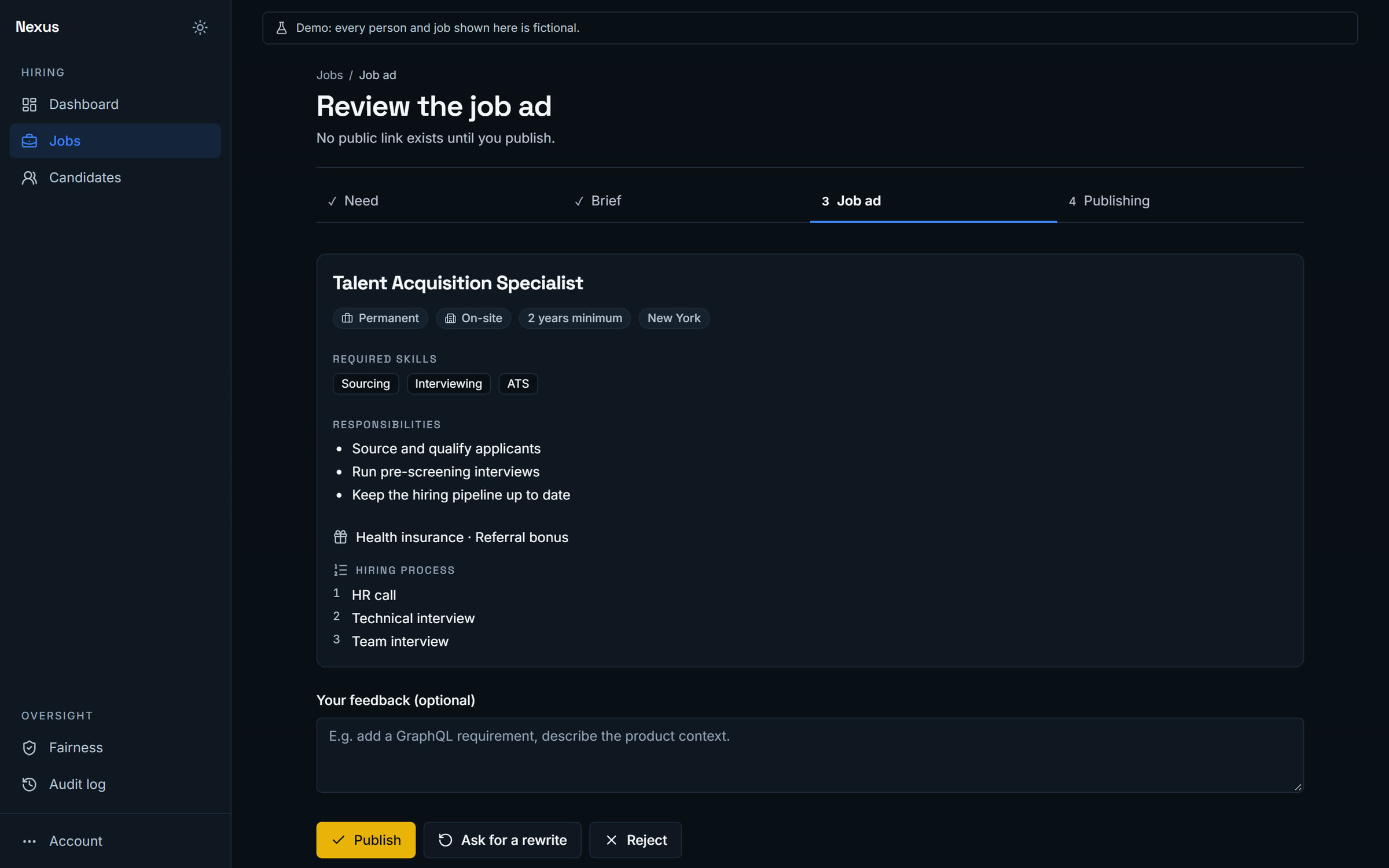
Why this step existsThe ad is what candidates apply to. A person reads it and approves it before anyone can see it.
Approve the job ad
The review screen on the demonstration instance, shown for another fictional job.
You approve the ad
Title, responsibilities, skills, minimum experience, location, contract and work arrangement. Approve it, or say what to change and Nexus redrafts it.
Application page status
What happens nextCandidates apply on a public page, without creating an account.
Why this step existsA CV is unstructured text. Before anything can be compared, each one is turned into the same structured profile.
Receive applications
What is extracted from each CV
Skills, experience, education and past positions
Availability and region
Probable duplicates, flagged at 95% similarity
A CV over 30,000 characters or 30 pages is not processed: the application is marked as an error, with the reason.
What is ignored
Invisible text, such as white on white
Instructions written into a CV
Contact details, for every scoring step
You start the evaluation
Nothing is scored automatically. The button states how many applications it covers, and the click is recorded.
What happens nextEach application gets a score on five criteria, with its working shown.
Why this step existsA ranking is only useful if you can check it. The score is a fixed weighted sum, computed in code. Enter the values from any CV and you get the number Nexus would.
Compute a score Example configuration
0/100
Criterion
Weight
Score
Points
Same inputs, same result. Names, photos and contact details never enter the calculation.
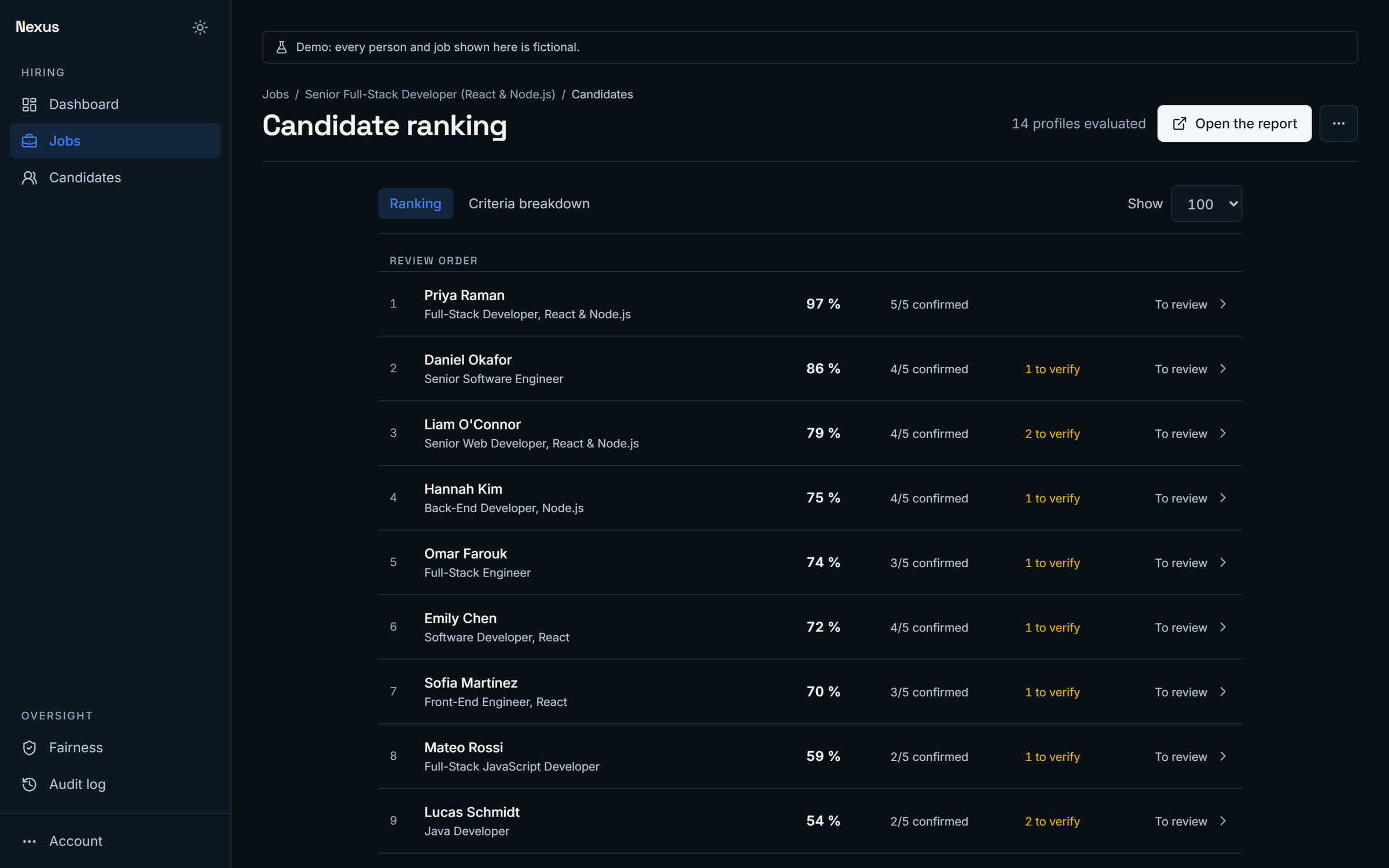
What happens nextCandidates are ranked by this score. The ranking is an order of review, not a decision.
Why this step existsThe score narrows the reading. The decision still needs a person who has read the file.
Review and decide
Demonstration instance. Every person and job shown is fictional.
Each required skill is marked as confirmed by the CV, or to verify in interview.
The model’s self-reported confidence is labeled as such, because it is not calibrated.
Team notes are signed and dated, and never change a score.
The report lists 1 to 20 finalists, with five interview questions each.
You mark the file as reviewed
The review is timestamped and attributed to you in the audit log.
What happens nextYour team interviews and decides, in its own process. Nexus does not schedule interviews or contact candidates.
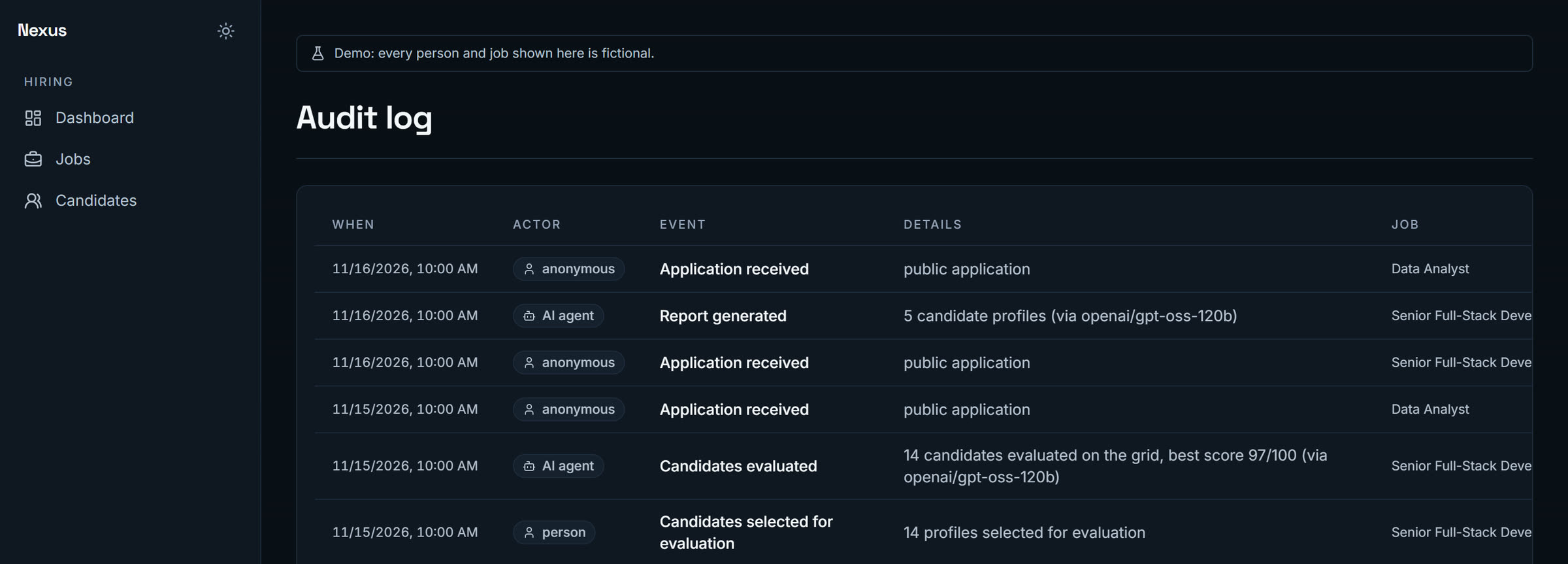
Why this step existsWhen a decision is questioned, by a candidate, a client or an auditor, you need to show who did what, when, and with which model.
Trace and hand off
The audit log separates what a person did from what the AI did, and names the model.
What you take away
The decision report, printable to PDF, exportable as HTML and Markdown
The audit log, exportable for your security and compliance teams
At the end of a pilot, a full data export, then complete erasure
Your own trail from this walkthrough
The same principle, applied to this page: every decision you made above, timestamped by your browser. Nothing leaves your device.
What happens nextSee it on your own roles, on a pilot instance dedicated to your organization.
Step 1 of 7
The same journey, filmed.
Under two minutes in the real product, on the demonstration instance, without voice-over.
Measured, with its limits stated.
Twin CVs that differ by one attribute are scored against the same job. The gap must stay within 3 points out of 100, a limit set before measuring. Measured on October 22, 2026, with real model calls on synthetic profiles.
1
point at most, when twins differ by gender, origin suggested by the name, age or place of residence.
2
points at most, when the same CV is written in English or in French.
0.43
points of standard deviation when a strong profile is scored eight times. 0.86 for an average one. Limit: 2.
What these numbers are not, and what we do not have yet
Not an adverse impact analysis on real applicants.
Not an independent audit. One model was tested.
No SOC 2 or ISO 27001 certification yet.
No conformity assessment under the EU AI Act yet.
See it on your own roles.
A pilot runs 8 to 12 weeks, on one or two of your open roles, on an instance dedicated to your organization. The measures are agreed before it starts.